AI & ML
Bayesian Inverse Problems for EUV reflectometry with regularized JKO scheme
arXiv cs.NA0 views
arXiv:2611.09574v1 Announce Type: new Abstract: We study a Bayesian inverse problem in EUV reflectometry, where optical constants and layer thicknesses are inferred from angle- and wavelength-resolved reflection measurements. The physical process is modeled and evaluated using an efficient forward model based on the transfer matrix method. As an alternative to computationally expensive sampling-based inference, we employ an Eulerian, entropically regularized Jordan-Kinderlehrer-Otto (JKO) scheme that minimizes the Kullback--Leibler divergence via proximal steps in the Wasserstein space. Using the Benamou--Brenier dynamic formulation and a Hopf-Cole transform, each JKO step is reformulated as a pair of heat equations coupled only through their initial and terminal conditions, enabling an efficient fixed-point solver. The resulting high-dimensional densities are discretized on tensor-product grids and represented in tensor-train format, exploiting Kronecker structure for scalable computation. Preconditioning based on estimated posterior moments further improves tractability. We test the method with numerical experiments on EUV reflectometry data for a ruthenium--silicon ($\ce{Ru}$ on $\ce{Si}$) specimen and compare the learned tensor-train posterior to ensemble Markov chain Monte Carlo (MCMC) reference samples. We demonstrate a use case in which we are able to reuse the tensor-train posterior to obtain samples for shifted target distributions with less computational effort than a comparable MCMC method.
Source:https://arxiv.org/abs/2611.09574PreviousSymmetric Zassenhaus splittings for bounded and unbounded operatorsNextA Hybrid Quantum-Classical Coarse-to-Fine Finite Element Solver for Heterogeneous Darcy Flow
Related posts

Nvidia investigating reports that CEO Jensen Huang was targeted by Chinese intelligence
0Phys.org Tech

Under fire over AI, effective altruism wants to tell its own story
0Phys.org Tech
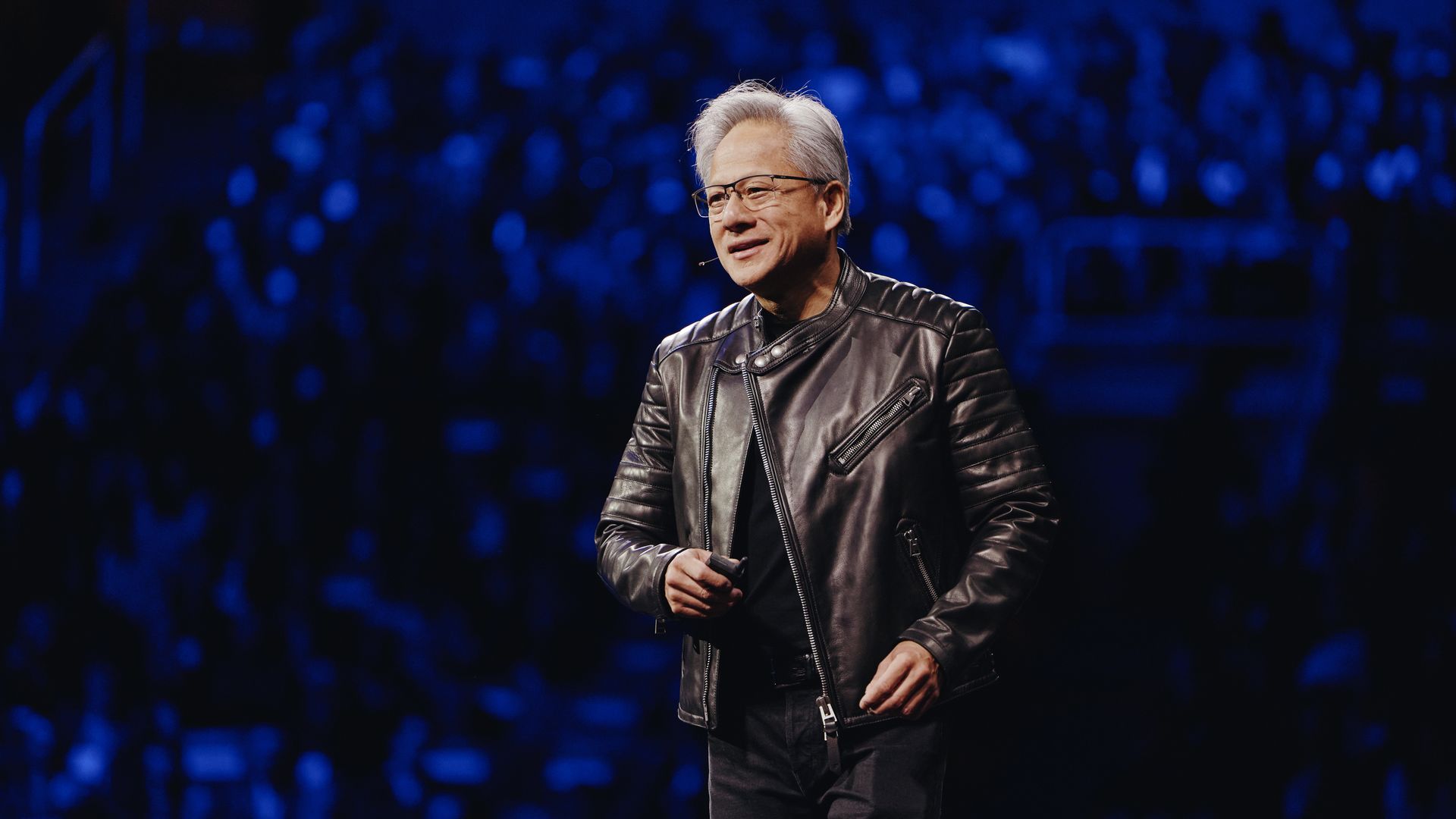
'I am deeply sorry': Jensen Huang affair with suspected Chinese spy sees Nvidia open investigation into its CEO — but what happens next?
0TechRadar

What free AI training in Nepal can teach you before you pay for a class
0dev.to

Agents draft. People decide.
0dev.to UX

โค้ดเพิ่ม 400% แต่คุณไม่ได้เร็วขึ้น 400%: GitHub ชี้คอขวดใหม่อยู่ที่การรีวิว
0dev.to GitHub