Open almost any developer tool's website in 2026, and you will see the same branding. A dark background. A violet or green gradient. A terminal window with a blinking cursor. A headline that promises to make engineers ten times faster, and a logo that could belong to any of the other forty tools in the category.
None of this is bad design. It is safe branding. And for a developer tool, safe branding has a real cost: the people you sell to have learned to scroll past it.
I run
Engineers don't buy adjectives
Engineering leaders read a landing page the way they read a pull request. They look for the claim, then for the proof, and they discount everything else. "Powerful," "seamless," and "next-generation" are noise to them. So is a hero illustration of glowing nodes.
What they respond to is logic. Show them how the thing works, in their own terms, and they will fill in the rest. That changes what a brand is for. A consumer product can sell a mood. A developer tool has to sell an explanation you can see.
Find the brand idea inside the product
The fastest way to an ownable brand is to stop looking at other brands and look at the product. Every serious tool has a mechanic at its core: a data model, a workflow, a way of moving work from one state to the next. That mechanic is almost always more distinctive than anything a moodboard will give you.
The test is simple. If one sentence explains the product and the same sentence can drive the logo, the copy and the interface, you have a branding idea. If every surface needs its own metaphor, you have a style.
A case: the SuperPlane brand
SuperPlane is an AI software factory built by the team behind Semaphore, the CI/CD platform. Agents take routine engineering tickets from issue to a review-ready pull request, and engineers step in only where judgment is needed. The company raised a $2.6M pre-seed round in June 2026.
The category problem was obvious from day one. Engineering leaders had seen every AI coding demo of the last two years. Another agent with another gradient would disappear.
The idea came from a line Elon Musk uses about companies: every person is a vector, and progress is their sum. We rewrote it for teams where agents do a growing share of the work. Every engineer and agent is a vector. Company progress is their sum.
A vector has length and direction. Agents add length: more work, done faster. Pointed in different directions, they cancel each other out and leave a mess in the codebase. SuperPlane sets the direction, so the work adds up.
That one sentence gave the brand one element to build everything on: the arrow.
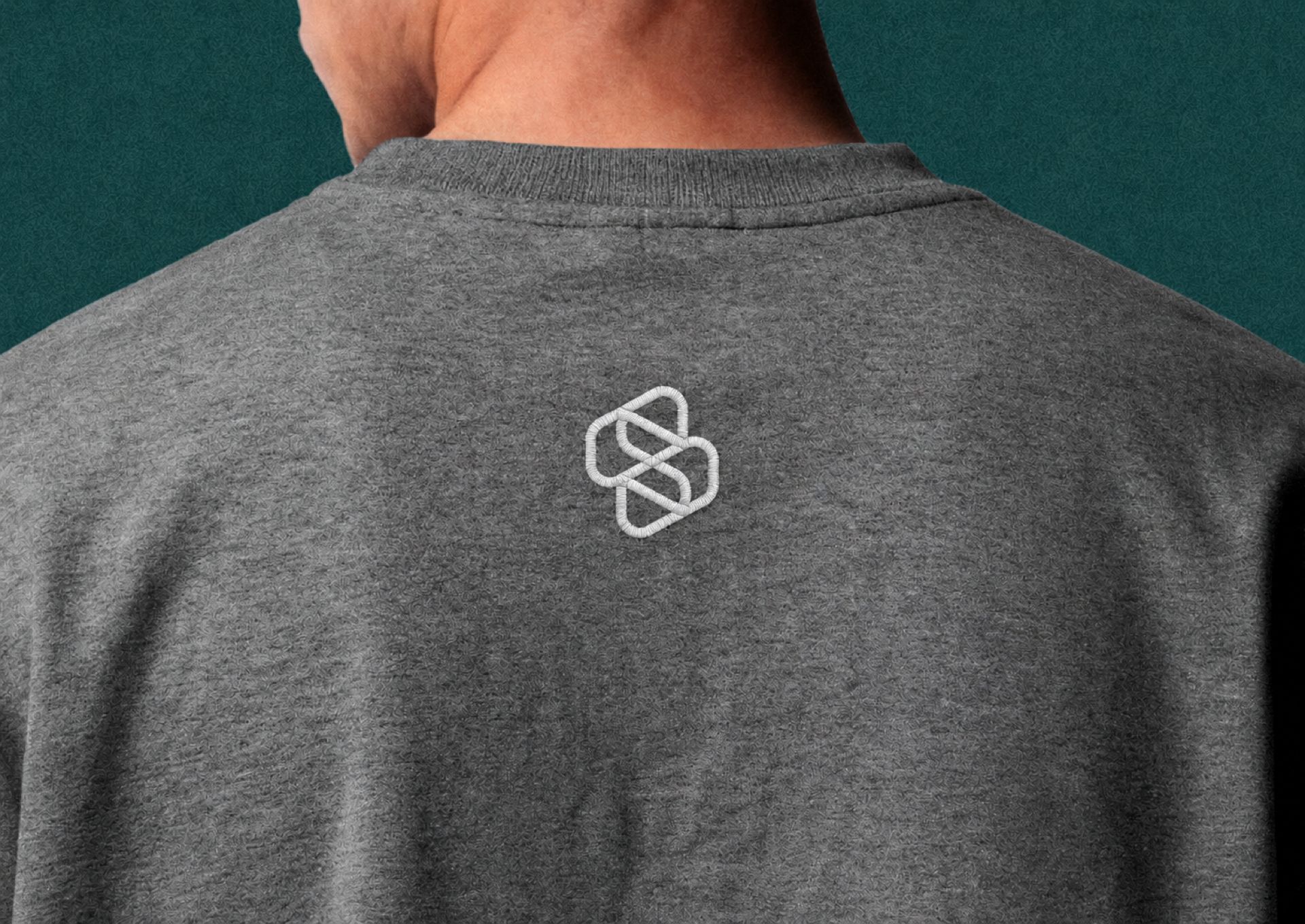
- The mark. Two workflow cards from the product interface, joined by a connector that bends into an S. It is the product's own diagram, not a symbol invented for a logo.
- The copy. Headlines are written as input → output: Issues → PRs. Detection → Recovery. The arrow works as a verb, and every line says what goes in and what comes out.
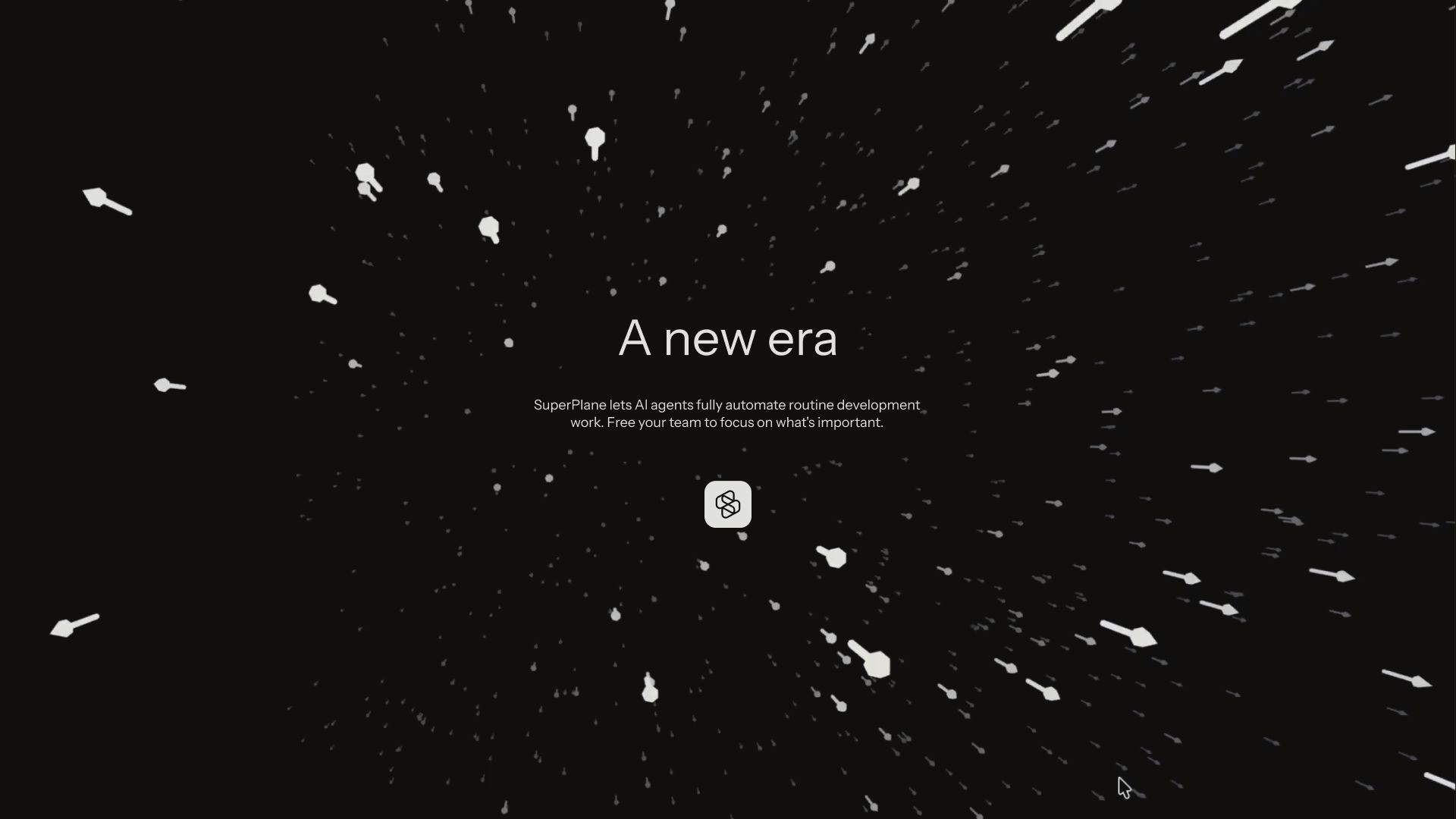
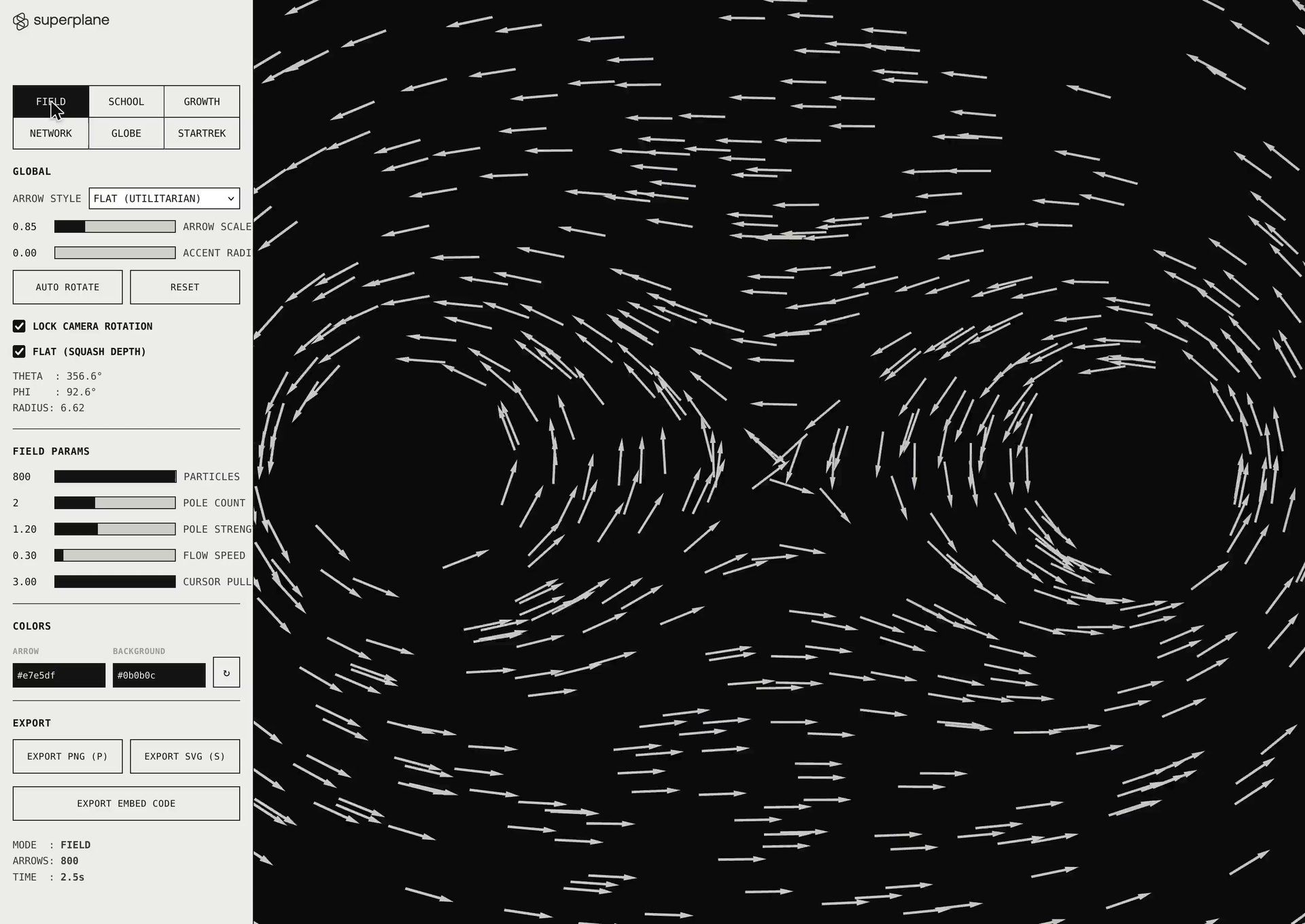
- The generative art. We wrote an engine where thousands of arrows move as a field and turn to follow the cursor. It runs live on the site and in the product's onboarding, and exports frames for posts and event screens.
- The website. The first screen makes one claim, that SuperPlane one-shots 30% of engineering tasks, and proves it right away with a live task board written in code, not recorded as a video.
The open-source engine behind SuperPlane has passed 8,000 stars on GitHub. A brand doesn't earn stars. But a brand that explains the product at a glance stays out of the way of the people who give them.
How to check that your brand idea holds
Before you commit to an identity for a developer tool, run it through the places where engineers actually meet your product:
- The README. Can the idea live in a monospaced file with no images? If it needs a gradient to work, it is a style.
- The docs. Does the idea help structure the documentation, or at least stay out of its way?
- The interface. Does anything in the product carry the idea: an icon, a state, a transition?
- The changelog. Can you write ten headlines in the brand's voice without reaching for "powerful"?
- A screenshot in Slack. Would a colleague recognize it as yours with the logo cropped out?
If the idea survives all five, it will survive the market.
What can wait
At seed stage, you don't need a mascot, a manifesto film or a 150-page guideline. You need one idea, a mark that comes from the product, a type and color system that works in dark mode, and a site that proves your main claim on the first screen. Everything else can grow from there.
This article was published under HackerNoon's Business Blogging program.