Lip-Bu Tan, chief executive of Intel, said on Thursday that yields of chips made using the company's latest 18A (1.8nm-class) fabrication process have achieved 70%, which is more or less in line with what one would expect from an all-new manufacturing technology at this stage of its ramp. In addition, Intel and Microsoft have signed an agreement under which Microsoft will secure Intel Xeon supply capacity for years to come and will use Intel's EMIB advanced packaging technology for in-house silicon.
"When I took over [as CEO in March, 2025], 18A yield was horrible; now we are at 70%," Lip-Bu Tan said at the TomorrowX conference (via @firesidealpha).
Lip-Bu Tan did not specify whether he meant functional yield, parametric yield, or percentage of sellable silicon. However, it is reasonable to expect a CEO of a semiconductor company to talk about functional die yield, the percentage of dies that pass basic electrical and functional testing.
Intel began volume production of compute tiles of its Core Ultra 300-series CPUs codenamed Panther Lake using 18A in the second half of 2025, so a 70% functional yield seems decent at this stage of the product ramp, though for Intel's economics a lot depends on parametric yield and how many advanced SKUs of Core Ultra 300-series 'Panther Lake' processors Intel can supply to customers at a premium. The same applies to Intel's Xeon 6+ Clearwater Forest processors with up to 288 cores that are in high-volume production now and which use 18A-based compute chiplets along with Foveros Direct 3D stacking.
In addition to announcing an important 18A milestone, Intel also signed a long-term agreement with Microsoft, under which the latter will secure multi-year Intel Xeon supply capacity, including supply of next-generation Xeon processors codenamed Diamond Rapids, and will use Intel's EMIB advanced packaging technology for multi-chiplet data center solutions developed in-house.
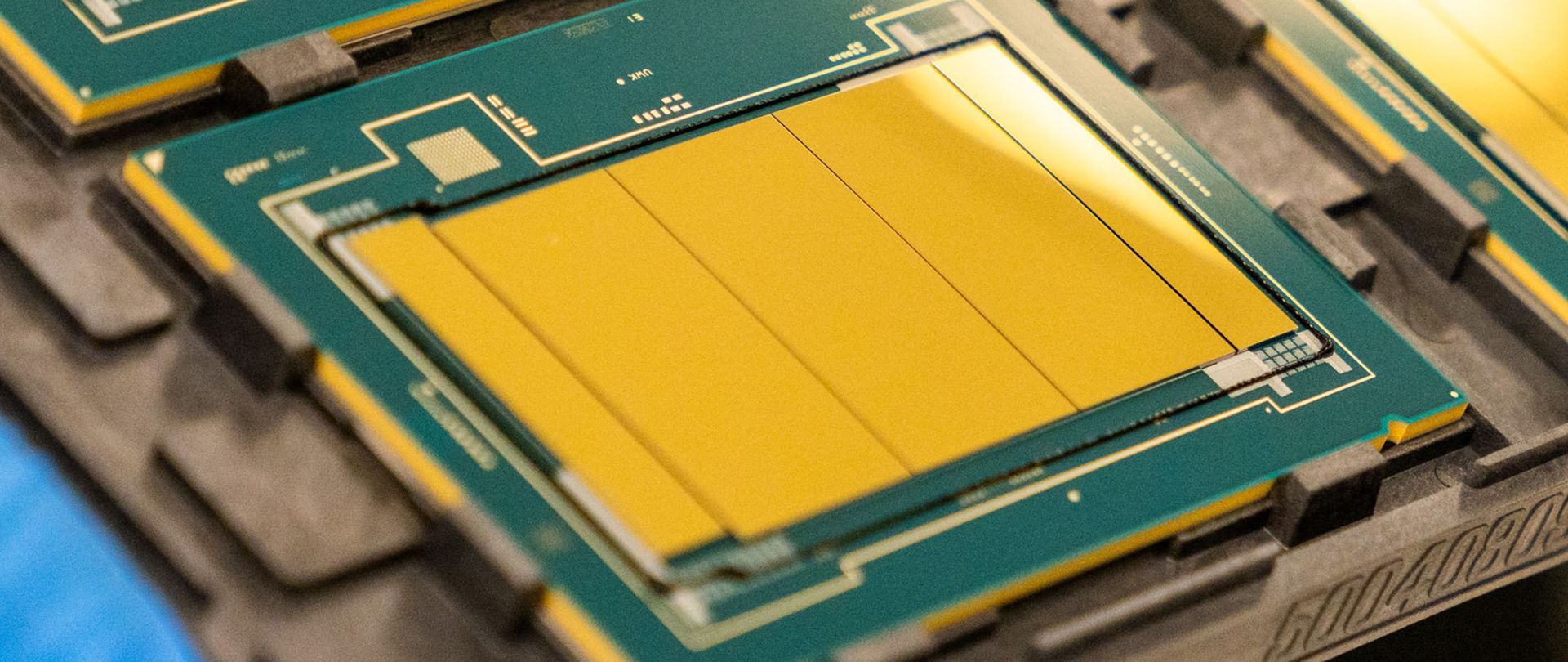
The EMIB agreement is arguably the biggest news. Microsoft is the first company to publicly commit to Intel's advanced packaging technology for its own silicon (i.e., it does not mean that Microsoft is the first third party to use EMIB; it is the first party to confirm usage of EMIB), which represents a significant commercial development for Intel Foundry in terms of publicity. However, the announcement does not identify the processors involved, their manufacturing process, production volumes, or deployment schedule. Microsoft was the first company to commit to use Intel's 18A for its data center silicon in 2024, though it is unclear whether the newly announced EMIB packaging agreement relates to the same solution or not. As the majority of high-end data center solutions tend to use multi-chiplet design, it is reasonable to expect Microsoft's future solutions for data centers to use EMIB for multi-die processors.
"Through use of our advanced packaging capabilities with EMIB to scale future generations of Azure infrastructure, Intel and Microsoft can combine the flexibility of heterogeneous integration with the manufacturing scale required for the AI era — giving customers new levels of performance and economics when interacting with Azure," said Naga Chandrasekaran, EVP, Chief Technology and Operations Officer and General Manager of Intel Foundry.
The Xeon agreement provides Intel with greater visibility into future server CPU demand. Importantly, Microsoft has committed to using Intel's next-generation Xeon 'Diamond Rapids,' although the announcement does not disclose purchase volumes or financial terms.
The collaboration extends beyond processor procurement and EMIB. Specifically, Intel and Microsoft are jointly developing infrastructure capabilities that encompass processor architecture, heterogeneous integration, CXL memory expansion, QuickAssist Technology (QAT) acceleration, and Trust Domain Extensions (TDX) security.