AI & ML
Task-Contribution Dynamics of Adam in Physics-Informed Neural Networks: Slow-Manifold Analysis and Gradient Modulation
arXiv cs.NA0 views
arXiv:2611.08910v1 Announce Type: new Abstract: Physics-informed neural networks (PINNs) often suffer from imbalanced optimization of competing loss components, particularly when approximating solutions with high-frequency or multiscale features. Although existing balancing strategies have proven effective in alleviating this difficulty, the mechanisms governing the evolution of individual task contributions to Adam's parameter updates remain insufficiently understood. We introduce task-wise indicators to characterize this evolution and identify three distinct training regimes: smooth variation, intermittent spikes, and persistent oscillations. Focusing on the early smooth regime, we combine discrete-time analysis with a continuous-time singular perturbation framework under the full-batch setting and the parameter regime $(1-\beta_2)/(1-\beta_1)\ll1$. A first-order approximation of the locally attracting slow manifold reveals two factors governing the step-to-step redistribution of task contributions: curvature-related alignment disparities and differences in the coordinatewise distributions of preconditioned task gradients. Both factors involve Adam's shared second-moment estimate. Inspired by AdaTask, we propose Gradient-Modulated Adam (GMAdam), which modulates incoming task gradients using task-specific second-moment estimates. Numerical experiments on high-frequency Poisson and wave equations, the Allen-Cahn equation, and two-dimensional lid-driven cavity flow ($Re=100,400$) demonstrate consistent improvements in predictive accuracy over AdaTask at comparable computational cost.
Source:https://arxiv.org/abs/2611.08910PreviousMultilevel kernel approximation of log-Euclidean manifold-valued functionsNextOn optimal convergence rates for parametrized variational problems with applications to nonlocal models
Related posts

Nvidia investigating reports that CEO Jensen Huang was targeted by Chinese intelligence
0Phys.org Tech

Under fire over AI, effective altruism wants to tell its own story
0Phys.org Tech
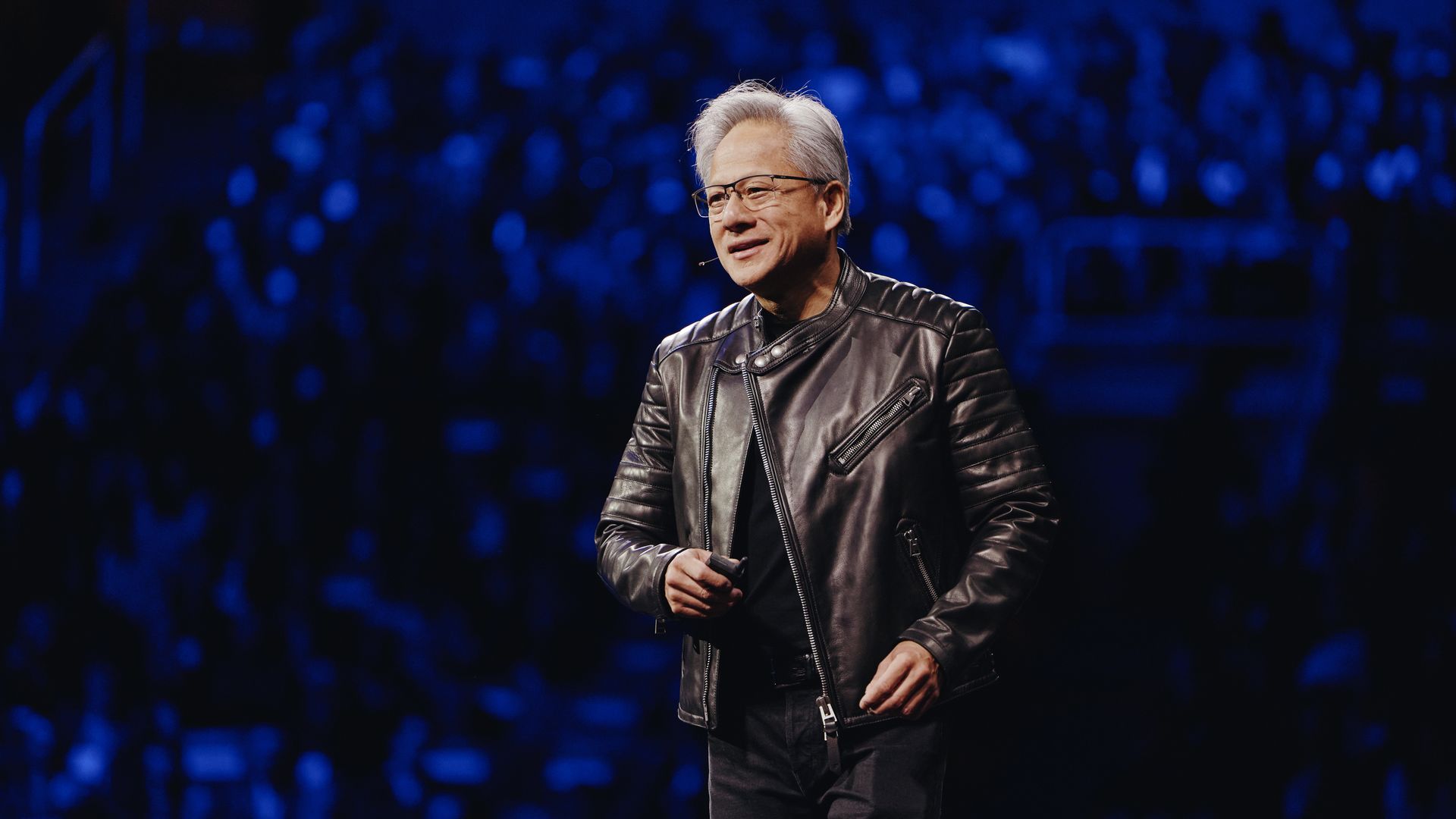
'I am deeply sorry': Jensen Huang affair with suspected Chinese spy sees Nvidia open investigation into its CEO — but what happens next?
0TechRadar

What free AI training in Nepal can teach you before you pay for a class
0dev.to

Agents draft. People decide.
0dev.to UX

โค้ดเพิ่ม 400% แต่คุณไม่ได้เร็วขึ้น 400%: GitHub ชี้คอขวดใหม่อยู่ที่การรีวิว
0dev.to GitHub