AI & ML
Understanding Double Descent through Universal Compression
arXiv stat.ML0 views
arXiv:2611.33759v1 Announce Type: new Abstract: Many deep learning models exhibit a double-descent phenomenon, where test loss exhibits a sharp peak near the interpolation threshold and then descends a second time as model size grows further, contrary to the U-shape predicted by the classical bias--variance tradeoff. The double-descent phenomenon has been found and explained in toy classical models, but is not well-understood in modern deep learning despite extensive empirical study. We interpret double descent through the novel lens of universal compression. Specifically, we upper bound the maximum-likelihood excess test loss as a sum of four terms: an approximation-and-shift term, a minimax batch regret, a prior cost, and an MLE-vs-Bayes gap. Under exact posterior sampling, we further show that the expected MLE-vs-ensemble gap lower-bounds the MLE-vs-Bayes gap in the well-specified setting. In our experiments, a Gaussian-prior SGLD approximation to the Bayes predictor, unlike SGD, shows no pronounced interpolation peak. Experiments with uniform random labels support this gap as a major contributor to the double-descent peak; here, the SGD cross-entropy is roughly four times the SGLD ensemble cross-entropy at the peak, while the ensemble cross-entropy remains near $\log 10$.
Source:https://arxiv.org/abs/2611.33759PreviousImproved Sample Complexity of Robust Reinforcement Learning with KL Uncertainty SetsNextRHOPE: LLM-Augmented Adaptive Experimental Design with Complex Contextual Information
Related posts

Here’s Everything You Can Do With With the New Gemini AI on Android Auto
0Wired
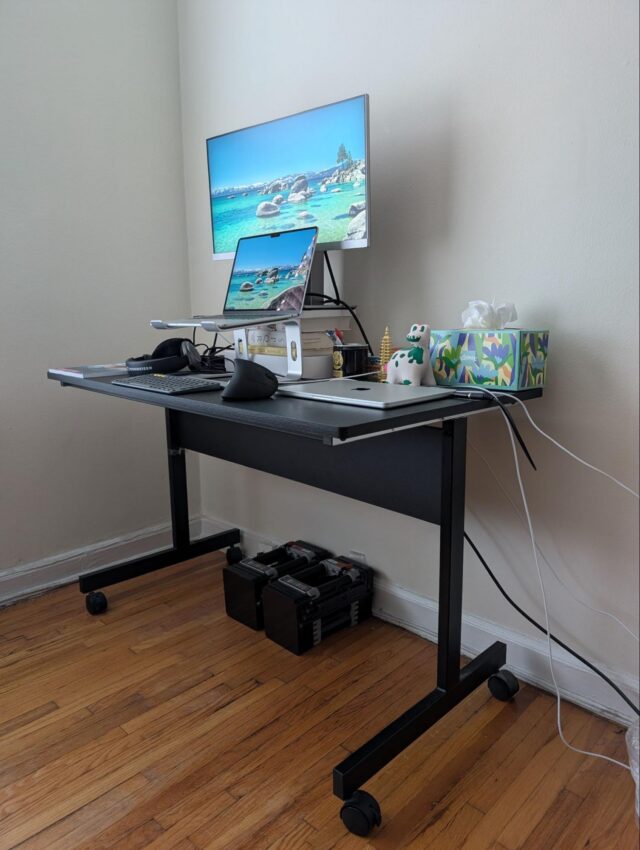
From minimalist to maximalist: Ars staffers show off their home offices
0Ars Technica

Draining peatlands is responsible for a few percent of our global warming
0Ars Technica

Waymo conquered city streets — why does it keep stumbling on freeways?
0The Verge

The Email That Should Have Been a Five-Minute Call
0dev.to

Which sites block GPTBot, ClaudeBot and PerplexityBot? The robots.txt files of 1,000 top domains
0dev.to