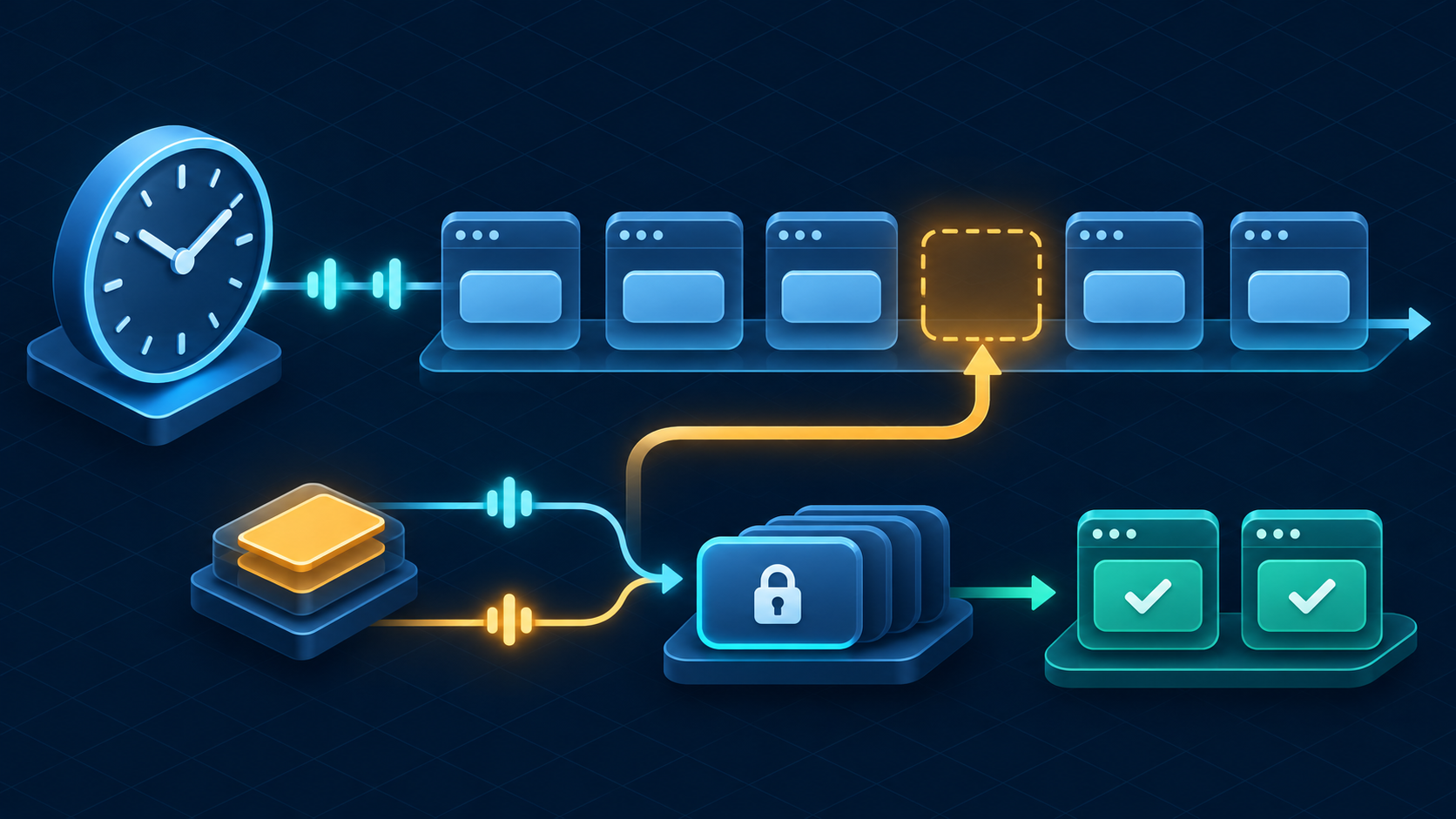
Summary: How does deployment architecture affect database acceptance effort? This article compares three GBase Database(GBase 8c) layouts across instance counts, port verification, connection testing, and fault localization, explaining why distributed database deployments benefit from automated acceptance checks.
Keywords: GBase Database, GBase Database 8c, Database Acceptance, Distributed Database Deployment, Database Health Checks, Database Connection Testing, Database Operations
Database acceptance is not just about confirming that an installation succeeded. The more complex the deployment architecture, the more components, ports, and connection paths need to be verified.
This article compares the acceptance effort across three GBase Database(GBase 8c) deployment layouts: minimal single node, single HA group, and default distributed.
This is not a performance comparison. It focuses on how deployment topology affects the amount of work required to verify that a database is ready for use.
1. Three Deployment Layouts at a Glance
The following table summarizes the main differences relevant to database acceptance.
| Dimension | Minimal single node | Single HA group | Default distributed |
|---|---|---|---|
| Hosts | 1 | 3 | 3 |
| Instances | 5 | 11 | 12 |
| DN groups | 1 | 1 | 2 |
| DN groups to check | 1 | 1 | 2 |
| Ports to verify | 5 | 8 | 10+ |
| Connection entries | 1 CN | 3 CN | 2 CN |
The instance count is only the starting point. Each additional component introduces more state to inspect, more ports to verify, or more connection paths to test.
2. Cluster State Verification: More Instances, More Checks
All three GBase Database layouts expose four main monitoring sections, but the amount of information inside each section differs.
The minimal single-node layout is relatively straightforward. With fewer instances, the cluster state can usually be reviewed at a glance.
The single HA group introduces more component instances across three hosts. Acceptance requires checking the expected roles and confirming that the components are running on the correct nodes.
The default distributed layout adds another layer of complexity: two DN groups, each requiring primary and standby verification.
It is no longer enough to see that all instances are running. The acceptance process must also confirm that each DN group has exactly one primary and that the replica distribution matches the intended topology.
The key difference is not how many monitoring sections exist, but how much state must be interpreted within them.
3. Port Verification: Topology Expands the Checklist
Port verification also becomes more demanding as the deployment grows.
For the minimal layout, the main service ports form a relatively small checklist.
The single HA group introduces additional ports, including proxy-related ports, which need to be checked alongside the main database services.
The default distributed layout requires checking more than ten ports, including two DN port ranges.
This affects more than local port listening checks. Firewall rules, network reachability, and connectivity between hosts must also be considered.
For GBase Database deployment acceptance, a port being open locally does not automatically prove that the application can reach the corresponding service remotely.
A complete port verification process should distinguish between:
- Whether the process is listening.
- Whether it is bound to the expected network interface.
- Whether the relevant firewall rules permit access.
- Whether the service is reachable from the intended client or application network.
As the number of ports and nodes increases, manual verification becomes more time-consuming and more prone to omissions.
4. Connection Testing: Verify Every Relevant Entry Point
Connection testing is another area where deployment topology changes acceptance effort.
In the minimal layout, there is one CN entry point to verify.
The single HA group has three CN instances, each of which deserves a connection check. Testing only one coordinator does not establish that all expected entry points are available.
The default distributed layout has two CN entry points. In addition to confirming connectivity, acceptance should verify that read and write operations reach the expected database roles.
For example, a successful connection alone does not prove that write operations are being handled by the intended primary.
A practical GBase Database acceptance checklist should therefore include:
- Connect through each expected CN entry point.
- Execute a basic read query.
- Execute a controlled write and verify the result.
- Confirm that the connection and operation behavior match the deployment design.
The objective is to validate actual database usability rather than simply confirm that a TCP connection can be established.
5. Fault Localization: More Hosts, a Larger Search Space
The number of hosts also affects troubleshooting and acceptance.
With a single host, the search space is relatively small. If a check fails, the investigation starts within one machine and its local components.
With three hosts, the team must distinguish between several possible failure locations:
- A specific host or operating system environment.
- A database component or DN group.
- The management or coordination layer.
- Network connectivity between nodes.
GBase Database monitoring output helps narrow down the problem, but interpreting distributed component states still requires familiarity with the architecture.
This is why acceptance effort increases with topology complexity even when the basic verification procedure remains the same.
6. How Long Does Acceptance Take?
Based on practical deployment experience, the three layouts have different approximate acceptance effort:
| Deployment layout | Estimated acceptance time |
|---|---|
| Minimal single node | Around 10 minutes |
| Single HA group | Around 20 minutes |
| Default distributed | Benefits from scripting |
These figures are indicative estimates, not official GBase Database acceptance standards.
Actual time depends on network conditions, environment readiness, the number of checks performed, and the experience of the delivery team.
The important observation is the relationship between architecture complexity and verification effort.
A minimal layout can often be checked manually without much overhead. A distributed deployment involves enough component states, ports, and connection paths that a scripted acceptance process becomes increasingly valuable.
7. Why Distributed Deployments Benefit From Automation
As the number of instances increases, manual acceptance creates two problems: repetitive work and inconsistent verification.
A scripted approach can standardize several tasks:
- Collect cluster monitoring output.
- Parse component states and primary/standby roles.
- Verify expected listening ports.
- Test CN connection availability.
- Execute basic SQL checks.
- Generate a structured acceptance report.
GBase Database provides structured monitoring and state output that can serve as the input for these checks.
The advantage of automation is not simply speed. It also makes acceptance criteria repeatable across different deployment layouts and delivery teams.
A script can apply the same verification logic every time, reducing the chance that an engineer overlooks a component or skips a connection entry.
Conclusion
The acceptance effort of GBase Database(GBase 8c) is closely related to deployment topology.
A minimal single-node layout has fewer components and a smaller verification scope. A single HA group introduces more instances, ports, and connection entries. A default distributed layout adds multiple DN groups and more demanding role verification.
The progression is clear: more distributed complexity requires more systematic acceptance.
For small deployments, manual checks may be sufficient. As the number of instances and connection paths grows, automated database health checks and structured acceptance reports become increasingly practical.
The best acceptance process is not the one with the fewest checks. It is the one that verifies every required component without depending on individual memory or experience.