- Ookla has found that North America, Europe, and Oceania have worse indoor mobile signal than other regions
- The difference in signal power can be up to around 50 times
- This is primarily down to these regions having poor outdoor signal in cities too
If you live in North America or Europe then you’ve probably frequently found that your phone’s signal is bad indoors — but the main reason might not be what you’d assume.
Ookla has carried out a study, comparing indoor and outdoor signal measurements across over 100 cities globally, and it has found that indoor signal is weakest in North America, Europe, and Oceania.
But if you assumed the problem was building materials, well, you’d be — mostly — wrong. According to Ookla, the material a building is constructed from can make a difference to a signal’s ability to pass through walls, but it’s not a dramatic difference, with timber-framed buildings reducing a signal by 2 dB (decibels), while concrete ones still only drop it by 7 dB, with the median drop being 4 dB.
That accounts for under a tenth of the overall difference in indoor signal between different cities and regions, with 85% of the difference coming from how good the outdoor signal is. So in other words, cities with better outdoor signal tend to have better indoor signal, too — which isn't entirely surprising.
A 50x difference
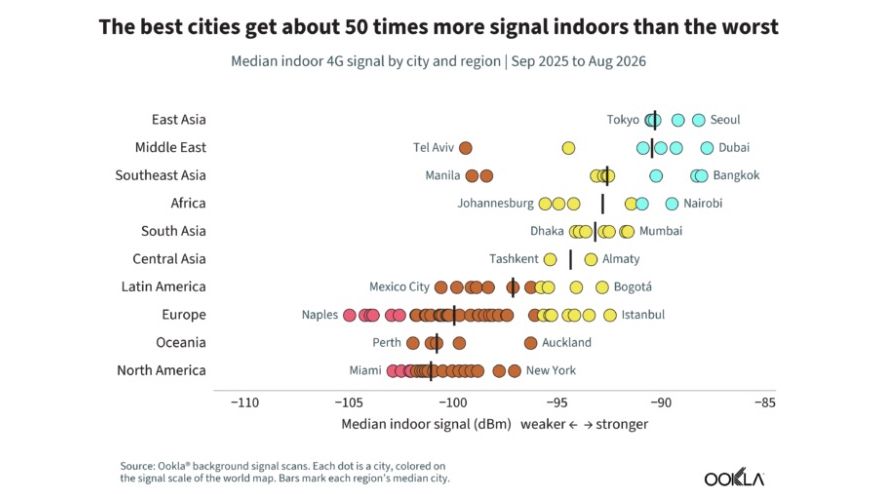
These differences are surprisingly big, with the median indoor signal measured in the likes of Dubai, Bangkok, and Seoul being around -88 dBm (decibel-milliwatts) on 4G, whereas in Naples it’s -105 dBm and in Geneva and Birmingham it’s -104 dBm. Numbers closer to zero are better here, and that roughly -17 dBm gap is a difference of around 50 times in signal power.
Overall, North American cities have a median signal of -101 dBm, with European ones similarly posting a median of -100 dBm, while in for example East Asia the median is -90 dBm — making for a much better signal.
So even though your signal might not seem bad outside, it likely is if you’re getting poor indoor signal — it’s just the move to indoors decreases it ever further, making it more noticeable.
The solution is for carriers to rethink their network deployment, with for example a denser deployment of masts and other infrastructure, or the use of more or better configured spectrum.
Still, without changes at a government level, this probably won’t be addressed, with Ookla noting that cities and countries that have indoor-specific rules for coverage tend to perform better than those that don’t.